Split your first-aid kit into two clear boxes
Home first-aid kits get messy: everyday bandages sit next to rarely used gauze and splints, and the bandages end up outside the box. Splitting the kit fixed it.
Separate the kit
Broadly it breaks down into three categories:
| Type | Symptoms | Contents |
|---|---|---|
| Major injury | Fracture, sprain, contusion | Bandages, scissors, triangular bandage, large patches, gauze, tape |
| Minor injury | Scrapes, small cuts | Bandages (many sizes), tweezers, small ointments |
| Colds | Fever, sore throat | Fever reducer, throat spray, lozenges, Kakkonto, etc. |
Major injury gear is big and rarely used (maybe every few months). Scrapes/cuts are weekly. So move the bulky, rare items into a separate box and stash it higher/deeper. Label the side with contents and expiration dates so you do not have to open it.
What remains is the “daily” kit.
Daily kit = many small items
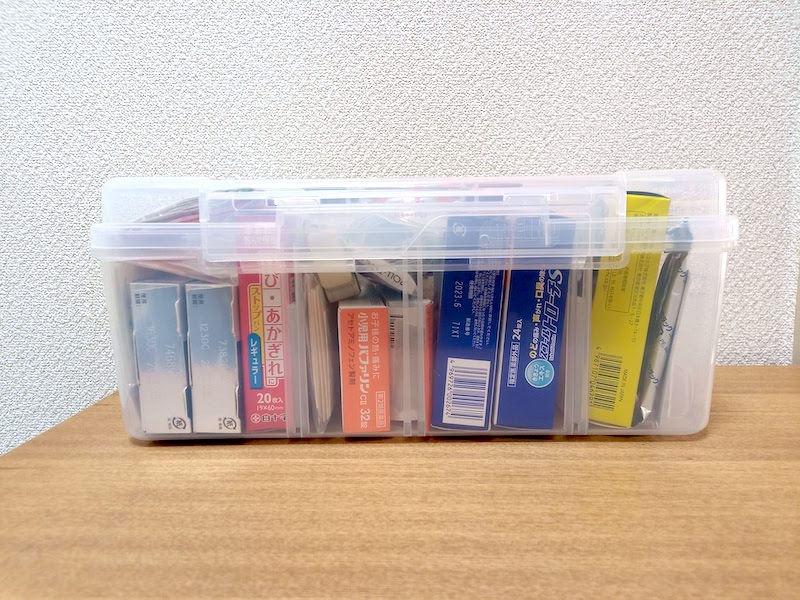
Bandages never quite fit: wounds differ, fingertip needs special sizes, and you heal before finishing a box, so varieties pile up. Medicines also diverge: adult vs. child doses; even headache meds differ by person.
Result: lots of similar-but-different items, half-empty boxes taking space. The fix is to re-pack.
Re-pack into clear bags
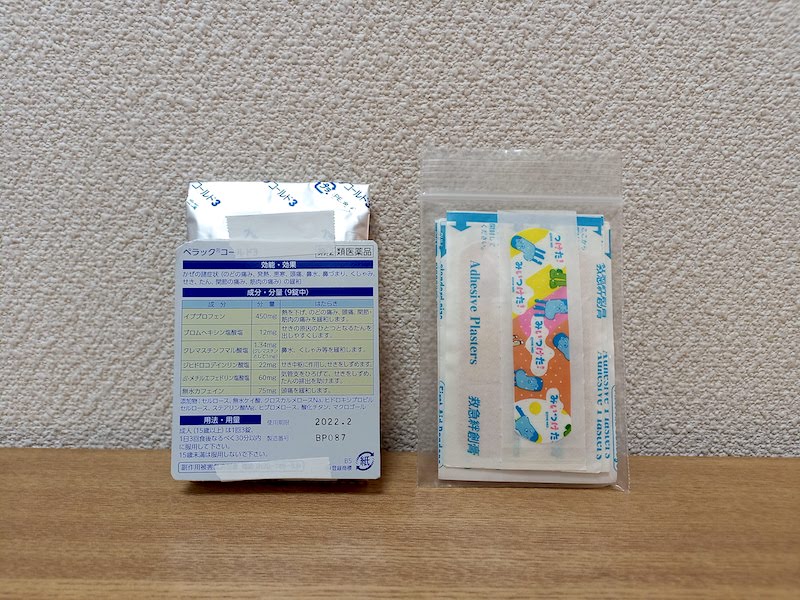
Use zip bags. Combine bandages where possible. This cuts wasted space and makes remaining amounts visible. If you need the package instructions (e.g., for meds), cut out that panel and tuck it in the bag.
Use a clear box

Traditional wooden boxes look nice but are heavy and small. Kits usually live in a cupboard, so looks matter less than visibility. A clear plastic case lets you see contents without opening it.
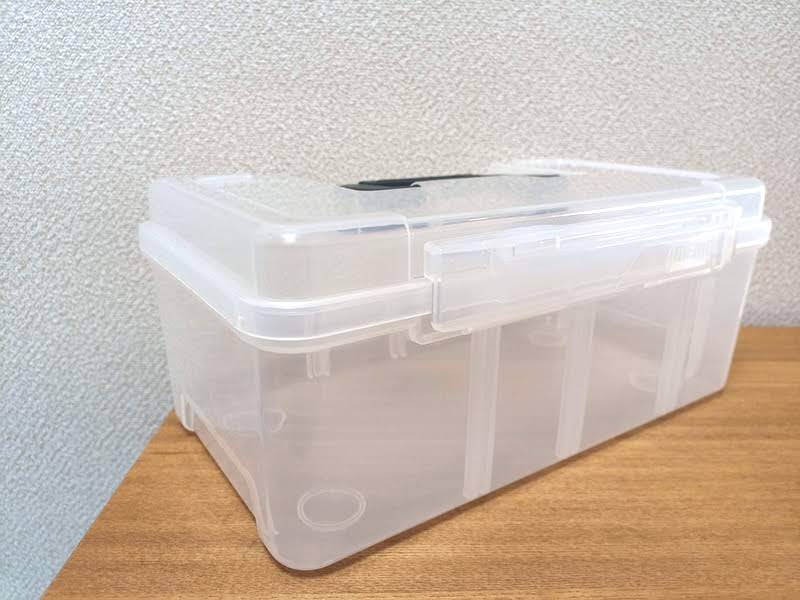
Avoid flimsy 100-yen cases—they warp and the handle pops off. We use a Meiho Handy Box; it is light but rigid and quite durable (almost a tool box). Build quality keeps it from feeling cheap.
Size: about 30 cm W x 18 cm D x 12 cm H. We chose size S; there are M and L too (roughly 800/1,400 yen). Only S includes dividers, so S is great for the daily kit; L suits the major-injury box.
Meiho Handy Box search (JP Amazon)
Skip the inner tray
Toolbox-style trays make items harder to grab. Without a tray, tall items fit; new medicine boxes can stand upright, and bagged bandages can stand so they are not buried.
About Meiho
Meiho Chemical Industry Co., Ltd. mainly makes plastic tackle boxes for fishing. Niche, with few competitors. The boxes are tough, portable, and often have firm latches; some are sturdy enough to sit on.
They also stack cleverly: small parts cases nest perfectly into larger boxes, similar to Muji-style storage. Fun fact: TAMIYA even sells a Mini 4WD “Carry Pit” based on a Meiho box.
TAMIYA Mini 4WD Carry Pit (based on Meiho)
Takeaways
- Sort your kit by use: daily vs. rare major-injury; stash the rare box deeper.
- Use clear boxes and clear bags to see contents and stock levels.
- Meiho boxes are sturdy and affordable; good alternative to flimsy 100-yen cases.