How I killed food waste odors for about ¥20k
I live in Japan and summers mean the triangle strainer in the sink starts smelling fast. I tried sealing scraps in plastic bags and even in zip bags, but odor still leaked. Baking soda, citric acid, alcohol spray, wrapping in newspaper—nothing beat the stench. So I threw money at it.
Used a city subsidy to buy a food waste dryer for about half price
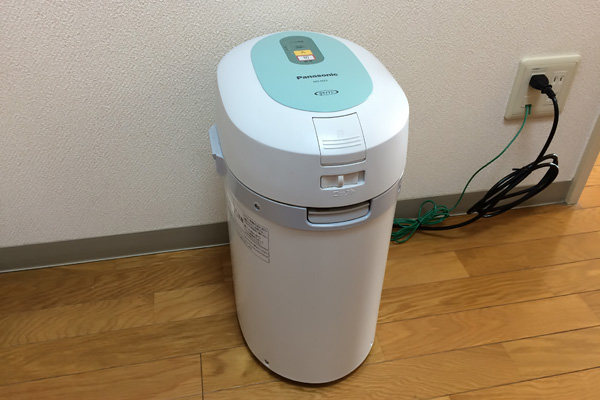
Most Japanese municipalities subsidize household food waste processors. Common rules: “up to half the base price, capped around ¥10k–¥30k”, whichever is smaller. That means a ¥60k machine can drop to ~¥30k. My city capped at ¥20k, so I bought Panasonic’s 3L model (list price around ¥40k at the time).
Panasonic sells two sizes; mine is the smaller one:
The larger one is taller and roughly ¥10k more:
What a food waste processor actually does
There are three types:
- Heats and dries scraps (takes about an hour).
- Uses bacteria to decompose slowly (takes days).
- A hybrid of both.
Mine is the heat-dry type, so here’s that experience. It stirs the scraps while blowing hot air, turning them into something like charcoal bits from a barbecue. The result is dry, crumbly, and easy to toss straight in the trash. Water weight is gone, so a week’s worth of dried waste stays light and compact.
Smell: almost none—just a faint toasted aroma. Once it’s in the trash bin, I don’t notice it at all.
In Japan burnable garbage pickup is usually twice a week, so food waste can sit at home for up to four days. In summer, untreated scraps reek after three days. With drying, there’s zero “rotten” smell, which is a huge relief.
Why subsidies exist
Eco-related appliances often get government support here (similar to the now-ended Eco-Point program). Food waste processors still get local subsidies, usually ¥10k–¥30k, but details vary by city, so check yours.
How to check if your city gives a subsidy (Japan)
Roughly 90% of municipalities seem to offer something. This site makes it easy to check: 日報ビジネス株式会社|全国自治体ごみリンク
Scroll a bit to see a list of prefectures; tap your area.

On the next page, if your city has a  (trash can icon), there’s a subsidy.
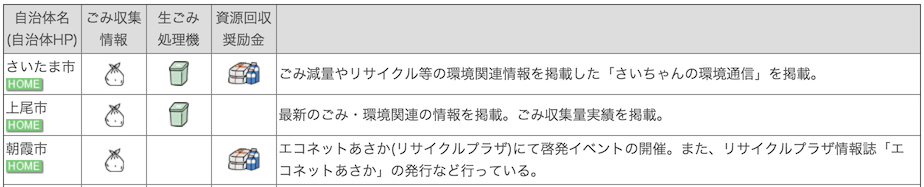
The icon is a link to your city’s page with details.
That site is a directory and may not be perfectly up to date, but the link points to the official city page, so you can confirm current rules there.
Watch where you buy
Some cities require you to purchase within the city to qualify. If you miss that detail, you could lose the subsidy. If unsure, call the city office.
My city was lenient: Amazon purchase plus a printed receipt was fine.
When subsidies don’t exist—or feel reluctant
Around 10% of cities pay nothing. Some argue that food waste dryers aren’t eco-friendly. Example: Musashino City (Tokyo, where Kichijoji is) ended its program because:
Food waste processors do reduce and recycle waste, but they create new environmental load, and over 60% of past recipients weren’t actually doing resource recovery. We abolished the subsidy in FY2008. 家庭用生ごみ処理機器購入費の補助制度廃止について |武蔵野市
They stopped because the dried waste wasn’t being reused. Instead, they subsidize composters that turn scraps into fertilizer. Some other cities take the same stance: no dryer subsidy, but composters are okay.
What’s a composter?
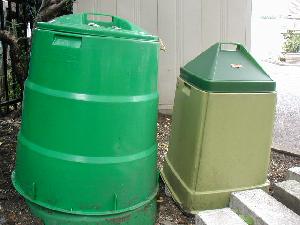 From Musashino City’s website
It’s basically a bin that ferments food scraps. Rural homes often have a plastic box in the yard; you toss scraps in and they become fertilizer—this is the “slow bacteria” type mentioned above.
Great if you garden; tedious if you don’t. Done poorly, it stinks and neighbors in tight housing may hate it. People struggle with maggots and smell (see these Japanese Q&A threads):
- コンポストのウジ虫大量発生。庭先に置いたコンポストが高速ウジ虫増殖炉にな… - Yahoo!知恵袋
- コンポストの悪臭に困っています!!臭いを消す方法教えて下さい!!!! - 庭… - Yahoo!知恵袋
Quick review of the dryer I bought
My impressions match what you’ll read on Amazon Japan:
How does the smell change?
It becomes a toasty, roasted smell. Right after drying, warmth makes it more noticeable; once cool, you barely smell anything.
How small does waste get?
Hot air removes moisture, shrinking scraps into something like dried fruit. Small, light, and crumbly—you can pour it into the trash easily.
How loud is it?
Noticeable but steady, so you adapt. For TV you might bump volume a notch; for games or reading it’s fine. You can converse next to it. Sleeping beside it would be hard; same for very quiet movies.
In a studio apartment it could be annoying, but there’s a timer to run it while you’re out.
Sounds come from:
- Fan in the lid
- Motor stirring the bucket
- Scraps clattering as they dry
The fan goes fooooo, the motor woiiiiiin, and the waste goes kasha-kasha.
Does it smell while running?
Not like food waste. Panasonic’s lower half is a deodorizing filter that grabs odors, so no “organic” smell. You may notice a slight chemical scent near the rear exhaust vent; step back and it fades. I don’t need to run the range hood.
Processing time?
Usually about an hour. The larger model also finishes in about an hour if not overloaded. A humidity sensor extends the cycle if scraps are very wet or if you didn’t drain them, and larger loads take longer.
What about breakdowns?
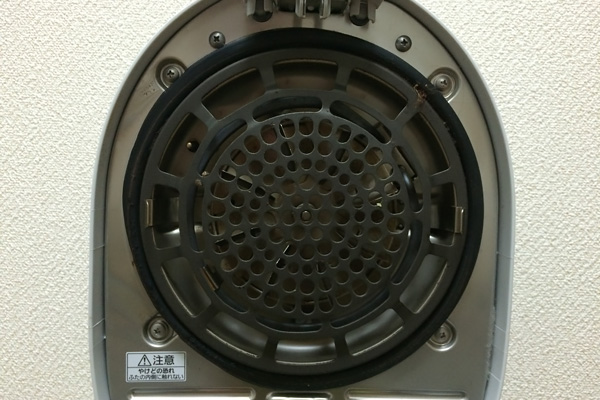
This is my second unit—the first (same size and design) died because corn silk got tangled in the lid fan. My mistake.
How it works: it heats and stirs waste in the bucket, while the lid fan pulls air through a filter to deodorize and exhaust it.
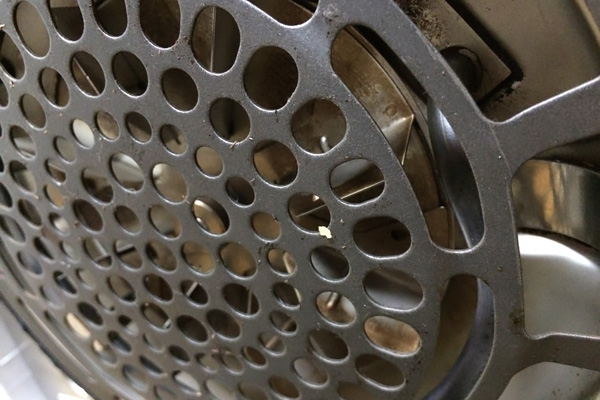
There’s a guard, but lightweight bits get sucked up—especially onion skins. Owners know the drill: process onions, open the lid, find a couple skins stuck there.
One summer we had tons of corn. I kept husks and silk in; eventually silk slipped through the guard, jammed the fan, and stopped it. When the fan stops, steam from the hot waste condenses under the lid and leaks out—unfiltered and horrendous. Condensation also formed in the exhaust pipe leading to the filter, filling the body with smelly liquid. The filter itself started emitting that stink, turning the machine into an odor cannon. I scrapped it.
This review describes similar symptoms (different cause): Amazonレビュー: パナソニック 家庭用生ごみ処理機 温風乾燥式 6L シルバー MS-N53-S
Does it make fertilizer?
Old models didn’t—the heat was too high. Models from 2009 onward add a “Soft Mode” that dries at lower temps, so you can use the output as fertilizer. It takes about 1.5× longer.
Power cost?
Panasonic says about ¥30 per run: 生ごみ処理機 | Panasonic
How big is it?
It’s noticeably large—like a slim stool.
Or think “slightly bigger trash bin.” Small kitchens might struggle with the footprint.
Can it be used outdoors?
Yes, on a covered balcony or porch. That’s handy if you have a garden and plan to use the dried waste as fertilizer.
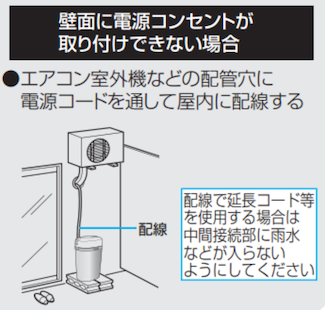
Power cable and ground wire are long because outdoor use is expected; the manual even shows routing through an AC duct hole.
Takeaway
If you’re fighting sink-strainer slime, hovering fruit flies, and summer stench, a food waste dryer is worth it—especially with a subsidy. If you’re in Japan, check your city here: 日報ビジネス株式会社|全国自治体ごみリンク