Running A/C all day cost about ¥30—tested cool vs dehumidify
Kanto’s rainy season ended and real heat arrived. Forecasts keep warning “Use your A/C to avoid heatstroke.” I still hesitated over cost and heard “dehumidify costs more.” I just wanted lower humidity without blowing the budget—so I measured it.
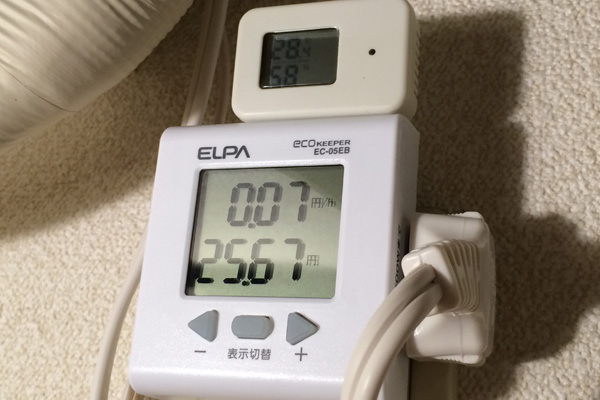
Used the Eco Keeper EC-05EB plug-in meter
It sits between the outlet and appliance and measures usage. Sanwa’s model shows first on Amazon for “electricity meter,” but this ELPA one looks identical and was ~¥1,000 cheaper.
Manual says:
Rated 1500W. Do not use with air conditioners or oil heaters.
Those can spike above 1500W. My tiny one-room A/C peaks around 700W in cool mode, so I took the risk.
24 hours: cool vs dry
Conditions:
- 4.5 tatami RC room
- 24 hours continuous
- 26°C setpoint; auto fan/swing
- A/C: Panasonic CS-221CF (2011 small model)
- Two similar hot clear days
Results:
| Time on | Cool | Dry |
|---|---|---|
| 24 h | ¥27.12 | ¥34.43 |
Dry was higher, but both were roughly ¥30/day.
_人人人人人人人人人人人_ > 30 yen per day!? <  ̄ Y^Y^Y^Y^Y^Y^Y^Y^Y^Y  ̄
Even a full month is ~¥930, so I’m fine leaving it on in August.
The photo up top was another test: 27°C dry for 24 hours = ¥25/day. With humidity in the 50% range, 27–28°C felt fine for just sitting around.
Cool vs dry—what’s the difference?
Cool = cool air; Dry = lower humidity. Both drip water outside, so I assumed both dehumidify like a cold drink sweats. I used dry, thinking it would cost less since I only wanted dehumidifying.
Later I heard “dry chills then reheats, so it costs more,” got spooked, and used only cool. In my tests, cool was cheaper and dry higher—but not by much. Why?
There are two kinds of dry: weak-cool dehumidify and reheat dehumidify.
Two dry modes
Sources from Daikin and TEPCO:
Weak-cool dehumidify
- Light dehumidifying (a “weak cool”)
- Often cheaper than cooling
- For hot, humid days
Reheat dehumidify
- Strong dehumidifying
- Heats the air after cooling → costs more
- On higher-end models
- For cooler, rainy-season days
Daikin says weak dry is cheaper; TEPCO agrees but notes some units may be cheaper on cool. Likely most modern units favor weak dry; my higher dry cost may be due to weather or unit behavior. Summary:
- Cool: coldest, highest dehumidifying; most power.
- Weak dry: light cooling/dehumidifying; less temp drop; cheaper.
- Reheat dry: heavy dehumidifying, then warms air; comfy but pricier than cool.
My cheap unit lacks reheat; I’ve never seen warm-air dry—maybe only in fancy homes.
Will it always be ¥30/day?
Environment matters: room size, doors opening, sun exposure, big windows, leaky wood frames, heavy PC workloads, three adults in the room, dirty filters, etc. In a typical small RC studio, ¥30/day seems plausible.
Ways to save on A/C
Think like a fridge: don’t leave the door open, don’t overstuff it, don’t set it too cold.
Don’t run it 24/7 if you’re out
For long absences, turn it off. People frame the debate as “always on vs frequent on/off,” but if no one’s home, shut it. My measurements: roughly ¥2 for the first hour, ¥1 per hour after (environment-dependent). Leaving it on 10 empty hours = ¥10; coming home and cooling = ~¥2.
Consider replacing an old unit
Like fridges, 10-year-old A/Cs can be inefficient and worn. Over a couple years the savings can offset the cost. If your unit stinks, yellows, or rattles and you have ~¥50k, a replacement could be worth it.
Use a circulator
Moves more air than a fan; evens room temps and lowers perceived heat so you can raise the setpoint. Also great for drying laundry; compact and handy.
Close curtains
Even sheer curtains help; blackout curtains while out reduce heat gain. Windows leak heat—summer sunlight or winter cold. South or west-facing rooms can stay hot into evening; curtains or window films help.