Deepening my milk knowledge with Snow Brand Acady
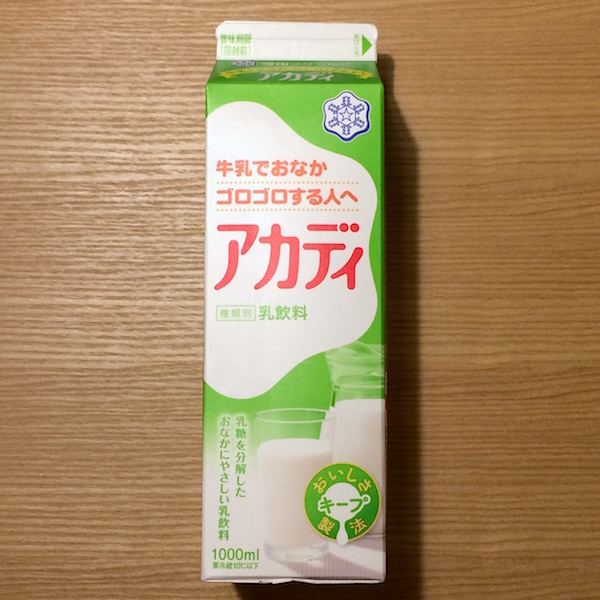
Regular milk hurts my stomach and, well, loosens things. As a kid I had phases of this; in junior/high school I could chug milk; as an adult the pain came back. No idea if it’s diet, lifestyle, or how I drink it. But switching to Acady (marketed as “gentle on the stomach”) stopped the pain.
Two years of Acady fan
Acady tastes good—slightly sweeter than regular milk, not watery, far nicer than low-fat processed milk (some of those taste like watered-down milk). Drawback: few stores stock it; no convenience stores.
I found it around 2014. The product existed earlier—renamed “MEGMILK Onaka ni Yasashiku” from 2009–2013, reportedly unpopular in taste, then reverted to Acady. Glad I missed that era.
Why Acady doesn’t hurt
The package says the lactose is already broken down. Lactose makes me think of a Japanese comedy bit (“cake, nyūtō🔪🍰”). Some say “cow’s milk is for calves; humans shouldn’t drink it 🐮.”
Quick sketch of what’s happening
Lactose is hard to break down. If the small intestine can’t keep up, lactose reaches the colon, raising osmotic pressure; water seeps in to dilute it. Too much water = it exits. That’s osmotic diarrhea—also seen with too much alcohol or laxatives.
Good source: J Milk
Searching “milk stomach pain” yields thin articles. A dairy industry group, J Milk, has better info. This PDF was clear:
📄 Differences in fermentation of lactose by gut bacteria cause lactose intolerance (PDF)
Summary: They tested lactose tolerance. A 50 kg woman could handle up to four milk bottles. Lactose breakdown is low for everyone compared to similar compounds, yet some people don’t get diarrhea even with lots. Gut bacteria in the colon seem to break it down; the amount of those bacteria matters.
They suggest: keep consuming dairy and the lactose-eating bacteria increase, boosting tolerance. Which bacteria? Not sure yet, but feeding them lactose seems to help.
Is lactose “bad”? Is milk only for cows?
Calves themselves get lactose-intolerant as adults—what? Enter mammal biology.
Mammals lose the enzyme as they grow
Babies have lactase to digest milk; once they eat other foods, lactase fades—called late-onset lactose intolerance. Makes sense: once you’re weaned, milk isn’t essential.
Humans are the oddball
Humans are the only mammals with many adults retaining lactase. Why?
- Maybe continual dairy consumption selected for it.
- Maybe lactase genes persisted because dairy was valuable.
Data points:
- Daily dairy can improve tolerance over time.
- Asians and Black populations show higher lactose intolerance.
- Northern Europeans (long dairy history) have lower rates than Southern Europeans; India also has higher rates.
J Milk notes that in Northern Europe (Norway/Sweden/Finland), dairy/cheese/butter were crucial; lactose intolerance is only 2–5%. Asians: ~95% intolerant.
Japan’s milk timeline: started in 645 CE
Japan’s first recorded milk drinking traces to the Taika Reform era (645 CE)—a monk named Dansei in Omi (Shiga) offered milk to Emperor Tenji. Later, “So” (a milk product) was a court tribute in the Nara period. For a country now known for limited lactose tolerance, the history is surprisingly old.
Why make lactose at all?
The Japan Dairy Association floated a hypothesis: lactose acts like a “filter.” If milk sugars were free glucose/galactose, both good and bad bacteria could feast. By bonding them into lactose, only certain “friendly” bacteria (lactase carriers) can use it—like encrypting data so only trusted parties can read it. Once “trained,” adults may no longer need the decryption key (lactase), so many lose it.
Dental tangent: cheese beats xylitol
In the same dairy materials, a table from WHO ranked caries risk:
| Evidence | 😇 Risk ↓ | Neutral | 😈 Risk ↑ |
|---|---|---|---|
| Certain | Fluoride coating | Starch (rice/potato/bread) | Sugar |
| Almost certain | Hard cheese, sugar-free gum | Fresh fruit | – |
| Possible | Xylitol, milk, fiber | – | Nutrient deficiency |
| Insufficient | Fresh fruit | – | Dried fruit |
So, hard cheese nearly certainly helps prevent cavities—stronger than xylitol. Mechanisms: sugar feeds bacteria → acid → enamel calcium dissolves. Milk/cheese don’t drop pH as much; they supply calcium (tricalcium phosphate), aiding remineralization; chewing boosts saliva, which has antimicrobial effects.
Saliva’s antimicrobial angle
My dentist found slow-moving cavities (a.k.a. “yukkuri mushiba”) behind a wisdom tooth and chose to monitor. They recommended a brush that reaches the back:
Saliva slows cavity progression; molars bathed in saliva are somewhat protected despite food sticking there. Chewing more = more saliva = good for teeth and digestion.
Takeaways
- Acady works for me because the lactose is pre-broken down.
- Lactose intolerance links to enzyme loss and gut bacteria; gradual dairy intake may improve tolerance.
- Humans uniquely retain lactase in some populations due to dietary history.
- Dairy may aid dental health (pH, calcium, saliva); hard cheese is a strong caries deterrent.